Watch the trailer
One car, then a fleet, then trains, aircraft and a world that never ends: the TinyFleet Free Open Beta trailer. Beside it, the same trailer cut for phones.
The stack
- Client: TypeScript, three.js and WebGL, built with Vite. There is no game engine underneath, and no plug-in or WebAssembly runtime to download.
- Server: one Node.js process speaking WebSockets, with PostgreSQL behind it. The same process serves this site and the game.
- Size: about a quarter of a million lines of TypeScript across the game and the server.
A world from a seed
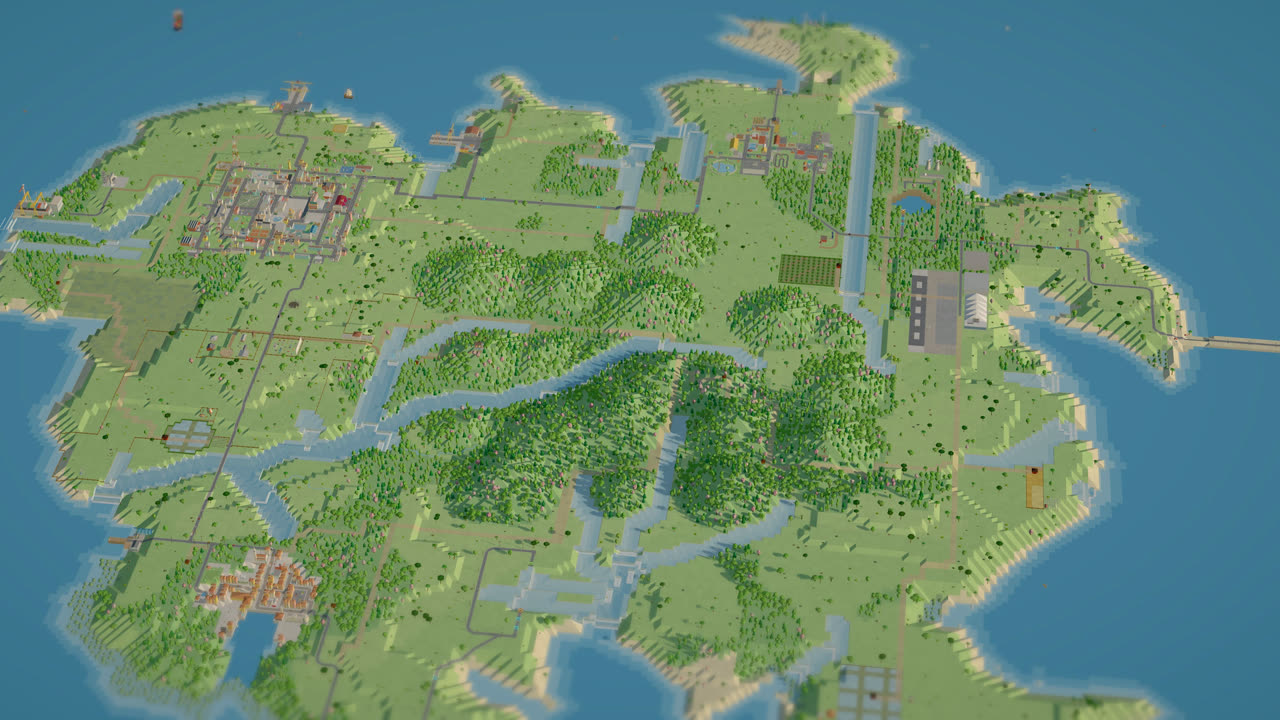
The world is divided into counties, and each county is generated from the world’s seed and its position: terrain, rivers, coast, biomes, then towns, roads, railways, farms, ports and airports laid over it. Generation is deterministic, so every player’s browser builds the same county from the same numbers, and nothing of the landscape has to be downloaded.
Counties are generated in web workers as you approach them, which is why the map has no edge and the game keeps drawing while new land is being made. Larger features are planned above the county level first, so mountain ranges, great rivers, interstates and main railway lines run across county borders instead of stopping at them.
Screenshots
Drawing it
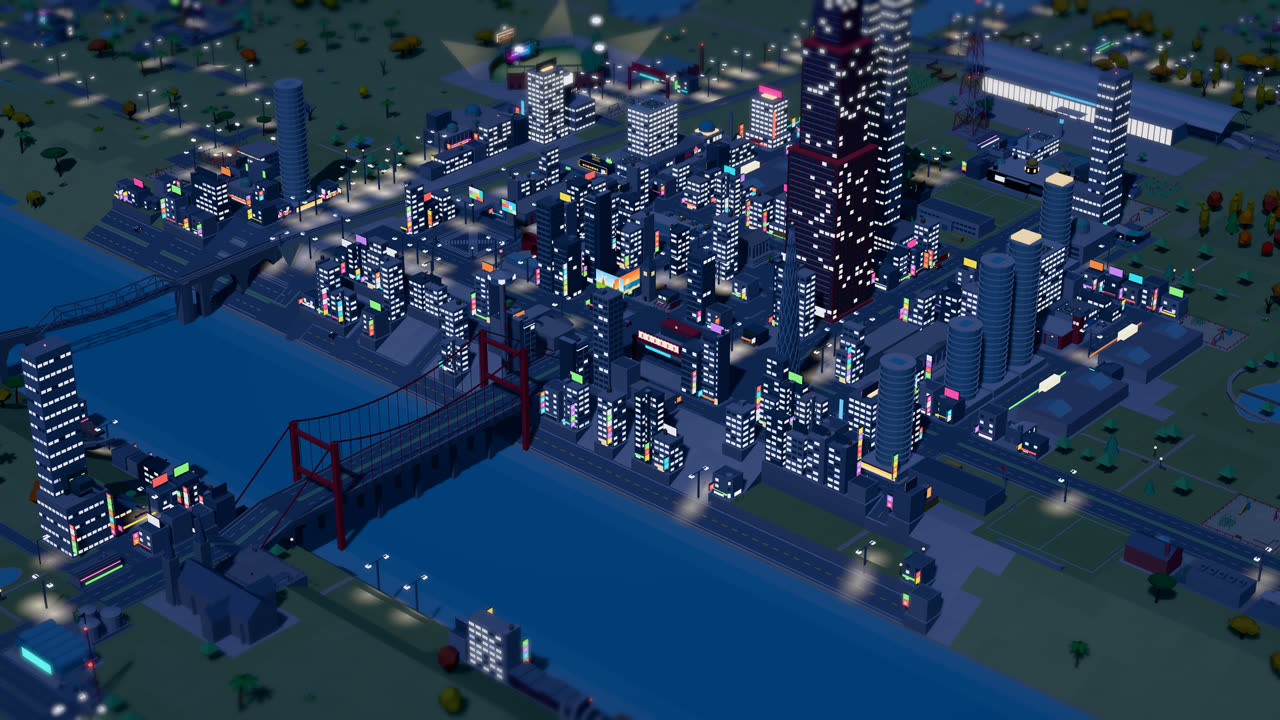
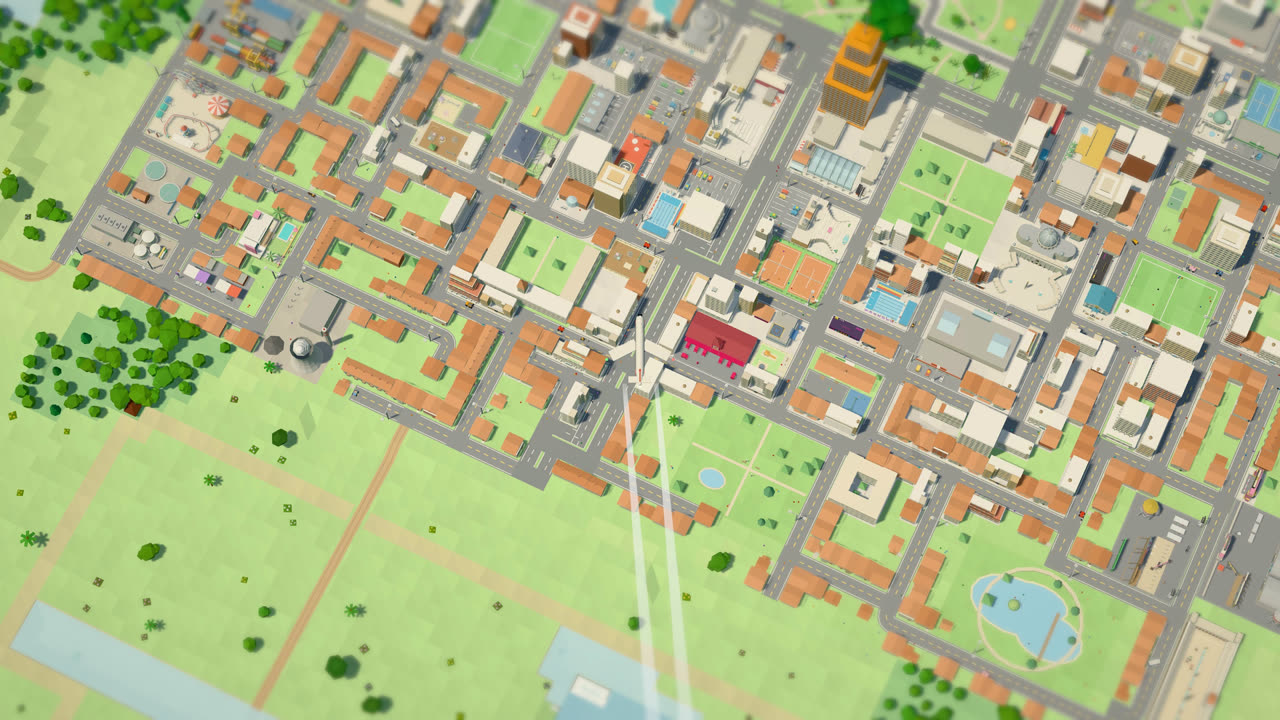
Buildings, vehicles and scenery are low-poly models built in code. Each county is cut into 16 by 16 tile chunks that are built and dropped as the camera moves, and distant land is drawn as simplified blocks, with their own lit windows at night, until you get close.
The miniature look comes from a narrow field of view and a tilt-shift blur above and below a band of focus. An Auto quality setting watches the frame rate and trades detail for speed to hold it steady, and shaders are compiled ahead of time under the loading screen so they do not stall the first time something new comes into view.
One shared world
Because every client generates the same land, the server only has to keep what players add to it: companies, vehicles and their positions, the roads, bridges, track and buildings players have put up, and the state of each town. Clients keep a WebSocket open to the server and exchange only that.
Things that are compared between players, such as challenge times, are measured on the server. The world’s generator has a version number, and the server will only talk to a client that generates the same version of the world.
Loading like a web page
The game is a single page of script and a handful of assets, served compressed. There is no install step, and a postcard link can open the game for someone new at an exact spot in the world. The same build is wrapped as the Windows and Mac apps.
See it running
The quickest way to judge any of this is to open the game and drive until the next county appears. For what the game is like to play, start with TinyFleet as a free browser game.
Questions and answers
What is TinyFleet built with?
TypeScript and three.js on WebGL in the browser, built with Vite, with a Node.js server using WebSockets and PostgreSQL.
Is the world really endless?
It has no edge. Counties are generated from a seed as you travel towards them, so the map continues in every direction.
How do all players see the same world?
World generation is deterministic. Every browser generates the same county from the same seed, and the server keeps only what players have changed or built.
Does it use a game engine such as Unity or Godot?
No. It is written directly on three.js and WebGL.
Does it need WebGPU?
No. It uses WebGL, which current desktop browsers support.
Play TinyFleet now
It is free to play in open beta and it runs in your browser. You will be driving in a few moments.
Play Now